In today’s fast-changing energy scene, picking the right BMS battery isn’t just a technical detail — it’s pretty much the key to making your energy storage work smoothly. The global market for energy storage is really picking up speed; a report from ResearchAndMarkets predicts it’ll grow at an eye-popping rate of over 24% annually from 2021 to 2026. Most of this growth comes from the skyrocketing demand for renewable energy sources and the need for solid energy storage systems that keep the grid stable and reliable.
Honestly, understanding your specific energy needs is a big deal when you’re choosing a BMS battery. Things like capacity, how many charge cycles it can handle, and safety features really matter if you want something that lasts and performs well. The International Energy Agency (IEA) even points out that energy storage isn’t just about holding power — it’s crucial for services like peak shaving, balancing grid frequency, and providing backup power. All of this stuff directly impacts how well electric grids and renewable energy projects work.
So, keeping an eye on market trends and new tech in Bms Batteries can really help folks and companies make smarter decisions. It’s all about picking solutions that fit your energy goals and give you peace of mind knowing you’re making a solid investment in the future.

What is a Battery Management System (BMS) and Its Importance?
A Battery Management System (BMS) is a crucial component in the realm of energy storage, serving as the brain that monitors and manages battery packs to ensure optimal performance and longevity. Its primary functions include balancing the charge across individual cells, protecting against overcharging and deep discharging, and providing temperature regulation. By doing so, the BMS enhances the reliability and safety of battery systems, which are increasingly pivotal in applications ranging from renewable energy storage to electric vehicles.
The importance of a BMS cannot be overstated, as it directly impacts both the efficiency and lifespan of battery units. A well-designed BMS not only maximizes the capacity of the battery but also mitigates risks such as thermal runaway, which can lead to catastrophic failures. Furthermore, it facilitates communication with other systems, enabling real-time data tracking and predictive maintenance. By integrating a robust BMS, users can gain insights into battery health, optimize charging cycles, and ultimately ensure that their energy storage solutions meet their specific needs effectively.
Understanding Different Types of Batteries Used in Energy Storage
Choosing the right battery management system (BMS) battery for your energy storage needs necessitates a fundamental understanding of the various battery types available on the market. Lithium-ion batteries are popular due to their high energy density and efficiency, making them suitable for a wide range of applications, from residential setups to large-scale grid storage. According to the International Energy Agency, the global demand for lithium-ion batteries is expected to grow by over 20% annually through 2030, driven by the increasing adoption of renewable energy sources and electric vehicles.
Lead-acid batteries, while providing lower energy density compared to their lithium counterparts, remain a reliable and cost-effective solution for specific applications, particularly in backup power systems. Their established technology and lower initial costs attract many users, despite their shorter lifespan and heavier weight. A report from BloombergNEF highlights that lead-acid batteries still account for a significant portion of the stationary energy storage market, emphasizing the importance of assessing your specific requirements before making a decision.
**Tips:** When selecting a battery type, consider your energy needs, space availability, and budget. Prioritize efficiency and longevity over initial cost to maximize your investment. Additionally, ensure compatibility with your existing energy management systems to enhance overall performance.
Key Factors to Consider When Selecting a BMS for Your Battery
When selecting a Battery Management System (BMS) for your energy storage needs, it’s essential to consider several key factors. First and foremost, the compatibility of the BMS with your battery chemistry is crucial. Different types of batteries, such as lithium-ion, lead-acid, or nickel-cadmium, require specific BMS configurations to ensure they operate efficiently and safely. Understanding the discharge rates and voltage requirements of your chosen battery type will help you find a BMS designed to handle those parameters effectively.
Another important factor is the level of monitoring and control the BMS offers. A robust system should provide real-time data on battery health, including state of charge (SOC) and state of health (SOH). Advanced BMS options may also include features like temperature regulation and balancing functions, which optimize the performance and longevity of the battery pack. Additionally, consider the scalability of the BMS. If your energy storage system is expected to expand in the future, selecting a BMS that can grow with your needs will save both time and resources in the long run. By carefully evaluating these factors, you can ensure that you choose the right BMS that aligns with your energy storage requirements.
Compatibility: Ensuring Your BMS Matches Your Battery Chemistry
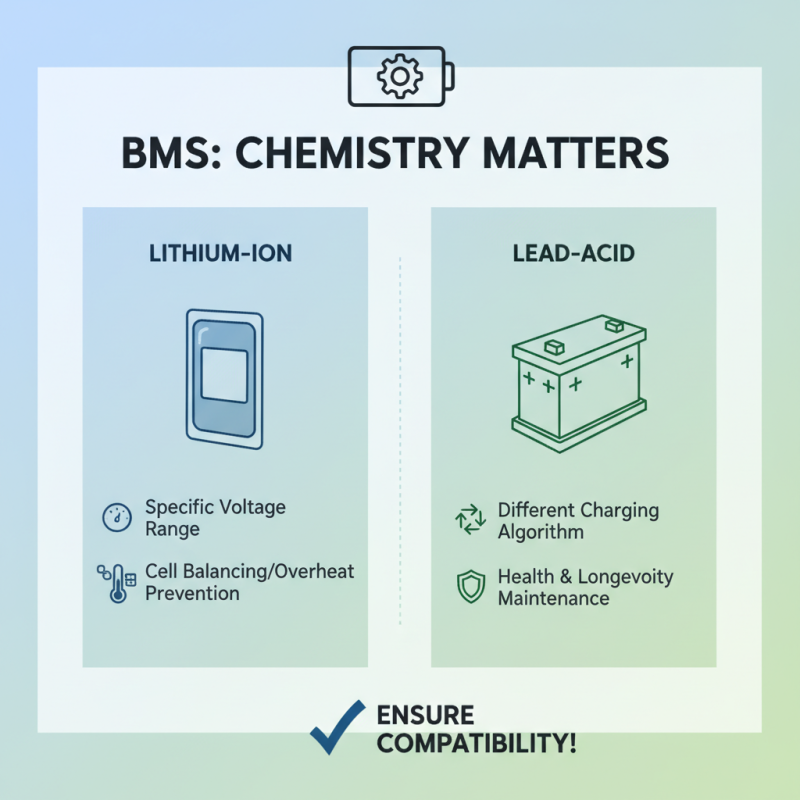
When selecting a Battery Management System (BMS) for your energy storage needs, compatibility with battery chemistry is crucial. Different battery types, such as lithium-ion, lead-acid, or nickel-based, have distinct charging and discharging profiles that a BMS must accommodate. For instance, lithium-ion batteries require a specific voltage range and careful monitoring of cell balance to prevent overheating, while lead-acid batteries need a different charging algorithm to maintain health and longevity. Therefore, it's essential to ensure that the BMS you choose is designed to effectively manage the specific requirements of your battery chemistry.
Additionally, understanding the intricacies of battery performance can guide your choice of BMS. Each battery chemistry has its own characteristics regarding cycle life, energy density, and operational temperature range, all of which the BMS must monitor. A compatible BMS will not only enhance the safety of the battery pack by preventing overcharging and deep discharging but will also optimize the performance and lifespan of the energy storage system. By prioritizing compatibility with your chosen battery type, you can ensure that your energy storage solution is efficient, reliable, and tailored to meet your specific energy storage requirements.
Evaluating Performance Metrics of BMS for Energy Efficiency
When evaluating performance metrics of Battery Management Systems (BMS) for energy efficiency, it is crucial to consider several key factors that directly impact the effectiveness and longevity of energy storage solutions. According to a report by the International Energy Agency (IEA), energy storage systems can improve overall grid efficiency by up to 30% when equipped with advanced BMS technology. This technology encompasses functionalities such as state-of-charge estimation, thermal management, and fault detection, all of which ensure safe and efficient battery operation.
A pivotal performance metric to look for in BMS is the efficiency of the charging and discharging cycle. A well-designed BMS can enhance cycle efficiency by minimizing energy losses during these processes. For instance, a system that achieves over 95% efficiency during peak operation periods can significantly reduce overall energy costs. Additionally, advanced BMS features such as predictive analytics can enable better decision-making regarding energy usage and storage, further optimizing efficiency gains.
Tips: When choosing a BMS for your energy storage solutions, prioritize models that offer real-time monitoring and data analytics capabilities. This ensures you can track the performance metrics continuously and make adjustments proactively. Additionally, assess the thermal management features of the BMS, as effective heat dissipation is vital for maintaining long-term battery health.
How to Choose the Right BMS Battery for Your Energy Storage Needs - Evaluating Performance Metrics of BMS for Energy Efficiency
| Battery Type | Capacity (Ah) | Voltage (V) | Cycle Life | Energy Density (Wh/kg) | Efficiency (%) |
| Lithium-ion | 100 | 3.7 | 5000 | 250 | 95 |
| Lead Acid | 120 | 12 | 300 | 50 | 80 |
| Nickel-Metal Hydride | 60 | 1.2 | 1000 | 100 | 85 |
| Lithium Iron Phosphate | 200 | 3.2 | 3000 | 150 | 90 |
Cost vs. Benefits: Assessing Your BMS Investment
When considering the investment in a Battery Management System (BMS) for your energy storage needs, it's crucial to weigh the costs against the benefits it brings to your setup. A well-designed BMS can enhance the performance, safety, and longevity of your battery system, which may justify higher upfront costs. Evaluating the specific features and functionalities of various BMS options will help you determine how they align with your energy goals, whether that's maximizing efficiency, improving energy capacity, or ensuring safety during operation.
Moreover, the long-term savings associated with a robust BMS can significantly outweigh initial investment costs. A reliable BMS can prevent battery failures, reduce maintenance needs, and extend the overall lifespan of your batteries, ultimately leading to lower replacement costs. In addition, the increased efficiency in energy management can lead to enhanced operational savings over time. Thus, thoroughly assessing the potential return on investment, considering both direct and indirect benefits, is key to making an informed choice that suits your energy storage aspirations.
Future Trends in BMS Technology for Energy Storage Solutions
The future of Battery Management System (BMS) technology is poised to transform energy storage solutions significantly. As the demand for efficient and reliable energy storage continues to grow, advancements in BMS technology are focusing on enhancing performance, safety, and longevity of battery systems. One of the key trends is the integration of artificial intelligence and machine learning algorithms into BMS design. These technologies can analyze data in real-time, predicting battery behaviors and optimizing charging and discharging cycles, ultimately improving the system’s efficiency and lifespan.
Another emerging trend is the increased use of modular BMS architectures. Modularity allows for scalable solutions that can be tailored to a wide range of applications, from small-scale residential systems to large industrial setups. This flexibility not only simplifies the maintenance and upgrading processes but also makes BMS units more adaptable to different battery chemistries and configurations. Furthermore, the focus on communication protocols is expanding, enabling better interoperability between different components of energy storage systems, which enhances overall system performance and provides users with more insights into their energy usage patterns.
Ultimate Guide to Choosing the Right BMS: Spotlight on the XJ-D482 13S 54.6V 30A for E-Bikes and Scooters
When it comes to optimizing performance in e-bikes and scooters, selecting the right battery management system (BMS) is crucial. The XJ-D482 model stands out with its ability to seamlessly support a 13-cell battery configuration, providing the efficiency and reliability needed for modern electric vehicles. With a maximum working current of 30A, it ensures that your ride delivers consistent power without compromising on safety.
One of the key features of the XJ-D482 is its compatibility with various battery chemistries. This adaptability allows users to tailor their battery setup to their specific needs, whether for commuting, recreational riding, or heavy-duty use. Its design also emphasizes thermal management and protection mechanisms, safeguarding both the battery and the vehicle's electronics.
In addition to performance benefits, the XJ-D482's user-friendly interface allows for easy monitoring and maintenance, making it an excellent choice for both enthusiasts and casual riders. With an emphasis on reliability and efficiency, this BMS is well-suited for anyone looking to enhance their electric riding experience.
FAQS
: A Battery Management System (BMS) is a critical component that monitors and manages battery packs to ensure their optimal performance and longevity by balancing charge, protecting against overcharging and deep discharging, and regulating temperature.
A BMS is essential as it impacts the efficiency and lifespan of battery units, maximizes capacity, mitigates risks such as thermal runaway, and facilitates communication for real-time data tracking and predictive maintenance.
Compatibility with battery chemistry is vital, as different battery types have specific charging and discharging profiles. A BMS must accommodate these differences to ensure safe and effective management of energy storage systems.
Each battery chemistry has unique characteristics regarding cycle life, energy density, and operational temperature range. A suitable BMS enhances the safety and performance of the energy storage system based on these factors.
Future trends in BMS technology include the integration of artificial intelligence and machine learning for real-time data analysis, modular architectures for scalable solutions, and enhanced communication protocols for better interoperability in energy storage systems.
Artificial intelligence enhances BMS functionality by analyzing data in real-time, predicting battery behaviors, and optimizing charging and discharging cycles, thereby improving efficiency and extending the battery’s lifespan.
Modular BMS architectures allow for flexible and scalable solutions that can be customized for a range of applications, simplifying maintenance and making them adaptable to various battery chemistries and configurations.
A BMS optimizes charging cycles by monitoring the battery's state and ensuring that it charges within the appropriate voltage range, thereby preventing overcharging and extending battery life.
Communication protocols in BMS technology enhance interoperability between different components of energy storage systems, improving overall system performance and providing users with deeper insights into energy usage patterns.
Conclusion
A Battery Management System (BMS) plays a crucial role in the efficient functioning and longevity of energy storage systems. Its importance lies in monitoring and controlling the performance of batteries, thereby enhancing safety and optimizing energy utilization. When selecting the right BMS battery for your needs, it’s essential to understand the various types of batteries available, as well as the key factors such as compatibility with battery chemistry, performance metrics for energy efficiency, and the cost-benefit ratio of the investment.
Evaluating a BMS entails ensuring it aligns with specific battery requirements while considering future trends that may influence technology advancements in energy storage solutions. By focusing on these aspects, users can make informed decisions, ensuring that their BMS battery not only meets their current energy storage needs but also prepares them for upcoming technological innovations.